Which AI Tool Can Separate Share Dilution from EPS Accretion?
A real Trade Inc Chat walkthrough separates ownership dilution from EPS growth, using net proceeds, three hypothetical earnings yields and an independently checked break-even hurdle.
By Trade Inc Research

Direct answer
Trade Inc Chat can help separate ownership dilution from earnings-per-share accretion in an explicit capital-raising scenario. In our actual Pro-account demonstration, it returned proceeds, ownership percentages, three EPS outcomes and a break-even yield. The useful output is an auditable calculation—not a verdict on whether a company should issue shares.
Our hypothetical investor's ownership falls from 1% to about 0.833% in every scenario. Yet EPS rises at the highest assumed earnings yield. Those statements are compatible: ownership measures a fraction of shares, while EPS also depends on the profit generated by the enlarged business.
Publisher disclosure: Trade Inc Research is part of Trade Inc. This walkthrough was checked on 12 October 2026. All transaction figures are hypothetical; no issuer, security recommendation or future return is being evaluated.
Key takeaways
- Ask for ownership and EPS separately; a smaller percentage does not automatically mean lower EPS.
- Calculate the earnings hurdle using net proceeds, after the assumed issuance costs.
- At a 5% after-tax yield, total profit increases but EPS still falls in this example.
- Preserving EPS is not the same as earning an adequate risk-adjusted return or protecting the share price.
1. Open Chat and specify the transaction before asking for a conclusion
We opened Percakapan, entered the scenario in the message box, left the response mode at Cepat, and pressed Kirim, the up-arrow send control. The screenshot below shows the submitted request and the beginning of the answer. The interface was Indonesian; the requested answer was English.
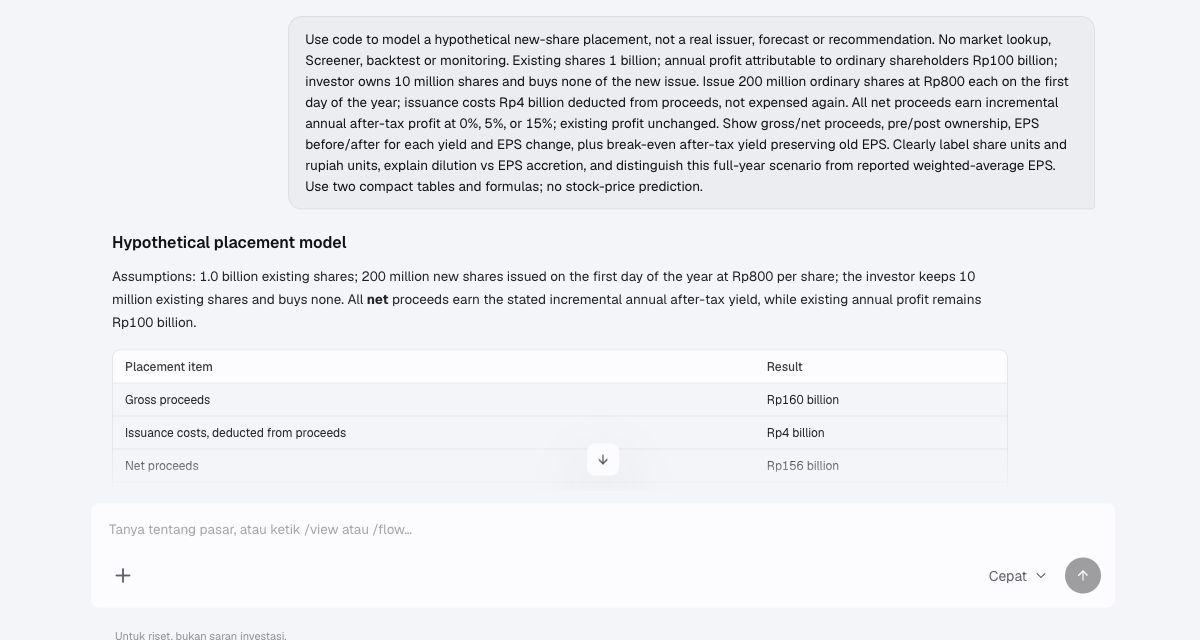
Step 1: actual submitted input. The send control is inactive in this captured state because the composer is empty after submission.
The scenario fixes the assumptions rather than asking AI to invent an investment outlook:
- One billion existing ordinary shares and Rp100 billion annual profit attributable to ordinary shareholders.
- An investor holds 10 million shares and buys none of the new issue.
- Two hundred million new ordinary shares are issued at Rp800 each on the first day of the year.
- Issuance costs of Rp4 billion reduce the proceeds; they are not expensed again in this simplified model.
- All net proceeds earn incremental annual after-tax profit at 0%, 5% or 15%. Existing profit is unchanged.
We requested two tables, formulas and a distinction between the full-year scenario and reported EPS. No market lookup, Screener, backtest or ongoing monitoring was requested.
This is a demonstrated Chat workflow, not a dedicated placement-analysis module. Trade Inc's public product page describes custom analysis within its Pro offering; that does not establish that every account, plan or future response will behave identically.
2. Reconcile the cash and share counts
The answer calculated Rp160 billion gross proceeds and Rp156 billion net proceeds. Shares increase to 1.2 billion. The investor still has 10 million shares, so ownership becomes 10 million ÷ 1.2 billion = 0.8333%.
That is a decline of about 0.1667 percentage points, or 16.67% relative to the original stake—not a 20% fall. Twenty percent is the increase in the company's share count, a different denominator.
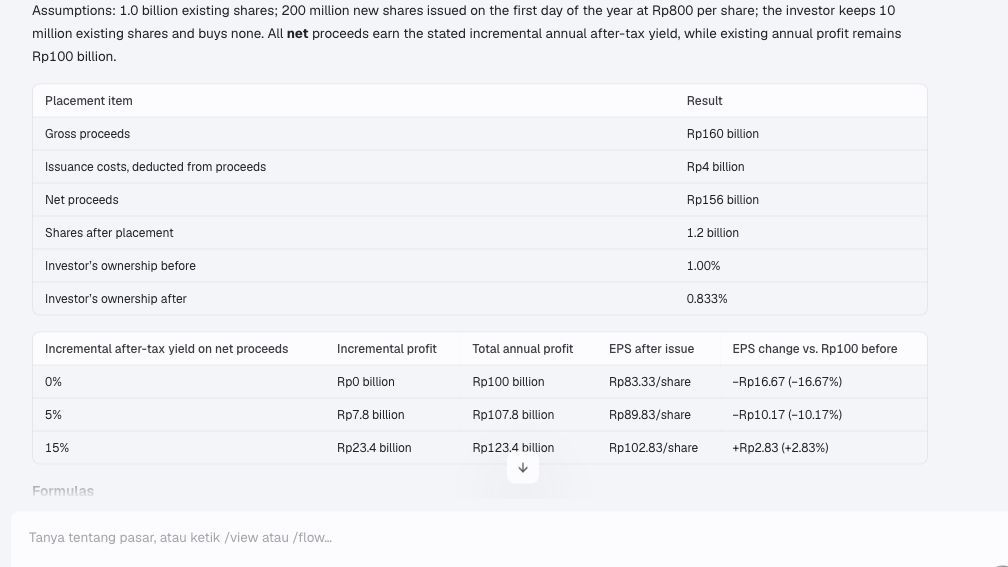
Step 2: the same ownership dilution accompanies different EPS outcomes. The figures are scenario results, not observed issuer performance.
3. Compare the EPS outcomes, then solve the hurdle
Before issuance, EPS is Rp100 billion ÷ one billion shares = Rp100 per share. We independently recalculated the displayed results:
| After-tax yield on net proceeds | Incremental profit | Total annual profit | EPS after issue | EPS change |
|---|---|---|---|---|
| 0% | Rp0 billion | Rp100 billion | Rp83.33 | −16.67% |
| 5% | Rp7.8 billion | Rp107.8 billion | Rp89.83 | −10.17% |
| 15% | Rp23.4 billion | Rp123.4 billion | Rp102.83 | +2.83% |
The middle row is the trap: the business earns more in total, but the new earnings are insufficient to offset the larger share denominator.
To preserve Rp100 EPS across 1.2 billion shares, annual profit must reach Rp120 billion. The extra Rp20 billion divided by Rp156 billion net proceeds gives 12.82% after tax. Using gross proceeds would give 12.5% and understate this model's hurdle.
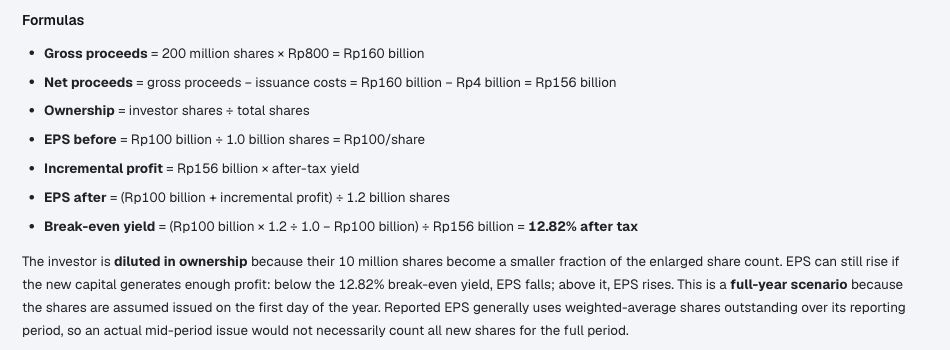
Step 3: inspect the formula behind the headline. A break-even yield is a required assumption, not evidence that a project can achieve it.
What this demonstration does not establish
The calculation assumes immediate, full-year deployment with unchanged existing earnings and no additional share changes. It does not model execution delays, losses, financing alternatives, complex securities or the applicable accounting treatment of an actual transaction. The treatment of costs here is an input assumption, not accounting advice.
Reported basic EPS uses a weighted-average share denominator and an appropriate attributable-earnings numerator. A mid-period issuance therefore needs a different reconciliation. This example is not a calculation of reported diluted EPS. Consult the issuer's EPS notes and applicable requirements; the IFRS Foundation's IAS 33 overview provides conceptual context.
Nor does EPS accretion prove value creation. The issue price, project risk, cost of capital and use of funds remain important. A 15% scenario here is not a forecast, a promised investor return or a share-price target.
Who needs this workflow?
Chat is useful when you want the assumptions, side-by-side scenarios and explanation in one conversation, and are prepared to verify the arithmetic. A calculator or spreadsheet is enough for a one-off calculation; a controlled spreadsheet may suit recurring models with many dependencies better. This walkthrough is not a competitor benchmark.
For an actual IDX placement, replace assumptions only after checking the official transaction documents, share timing, costs and earnings scope. Do not ask the model to fill missing facts with plausible numbers.
Conclusion
Ask two questions: How much does my ownership percentage change? What incremental profit would preserve EPS? Trade Inc Chat answered both in this tested scenario. The decision comes afterward, when you assess whether the use of funds can credibly clear an economically adequate hurdle.
For the accounting foundation, read why profit can rise while EPS falls. For a different investor decision, see the rights-issue scenario walkthrough.
This article is for research and information only. It is not personalized financial advice or an instruction to trade.