Which AI Tool Can Compare Exercising, Selling or Letting Rights Lapse?
An actual Chat walkthrough separates subscription cash, theoretical wealth and ownership dilution using one hypothetical rights issue and three choices.
By Trade Inc Research

Trade Inc Chat can compare the cash and ownership consequences of exercising, selling or letting rights expire in a hypothetical rights issue. In our actual product demonstration, it correctly separated a Rp1.4 million subscription payment from the investor’s theoretical wealth—and showed why selling rights is not the same as preserving an ownership percentage.
This is a calculation walkthrough, not a recommendation about a current IDX offer. Trade Inc publishes this guide about its own product. We tested an authenticated Pro session on 8 October 2026; that observation does not establish access under every plan.
Key takeaways
- A discounted subscription price is not free profit: the model also adjusts the value of the existing shares.
- Exercising and selling rights can preserve the same theoretical wealth, but only exercising preserves the original ownership percentage in this example.
- Letting valuable rights lapse gives up their modeled value. Actual outcomes depend on the offer terms, deadlines and executable prices.
Start with explicit terms in Chat
Open Trade Inc Chat, choose a new conversation, and enter the old share price, subscription ratio, subscription price and existing holding. Specify whether one right buys one new share; otherwise “value per right” can refer to a different unit.
Our illustrative inputs were Rp1,200 per old share, two new shares for every five old shares, a Rp700 subscription price and 5,000 old shares. We requested three scenarios and excluded fees, taxes and market changes. Press Kirim, the send-arrow button in the Indonesian interface.
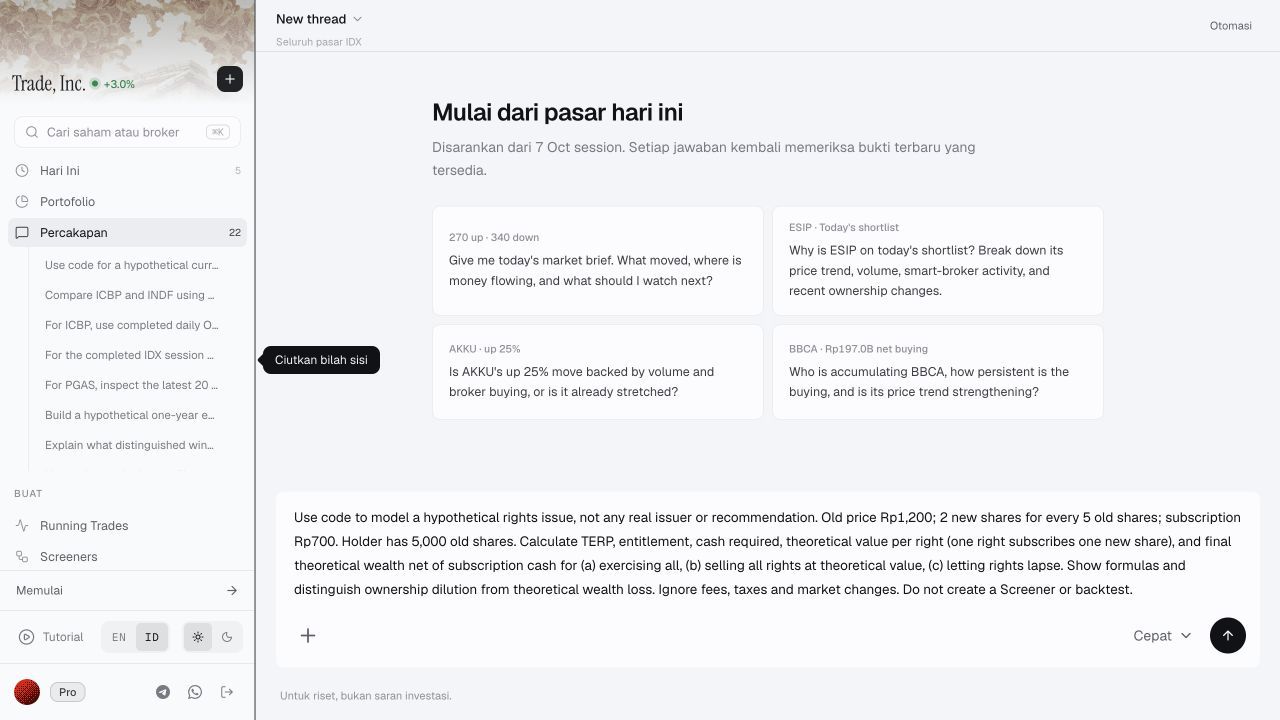
Step 1: the actual input screen before sending. No real issuer or live rights offer is modeled; unrelated start-screen suggestions are not inputs.
The first response returned the calculation. We then requested a compact table without mathematical markup, with rounding only at the end. This follow-up made the result easier to inspect; it did not change the assumptions.
Read the cash requirement separately from wealth
The theoretical ex-rights price, or TERP, spreads the old share value plus the new subscription money across the enlarged share count:
TERP = (5 × Rp1,200 + 2 × Rp700) ÷ 7 = Rp1,057.14 per share.
Entitlement is 5,000 × 2/5 = 2,000 new shares. Exercising costs 2,000 × Rp700 = Rp1,400,000. With one right buying one new share, its modeled value is TERP minus Rp700, or Rp357.14.
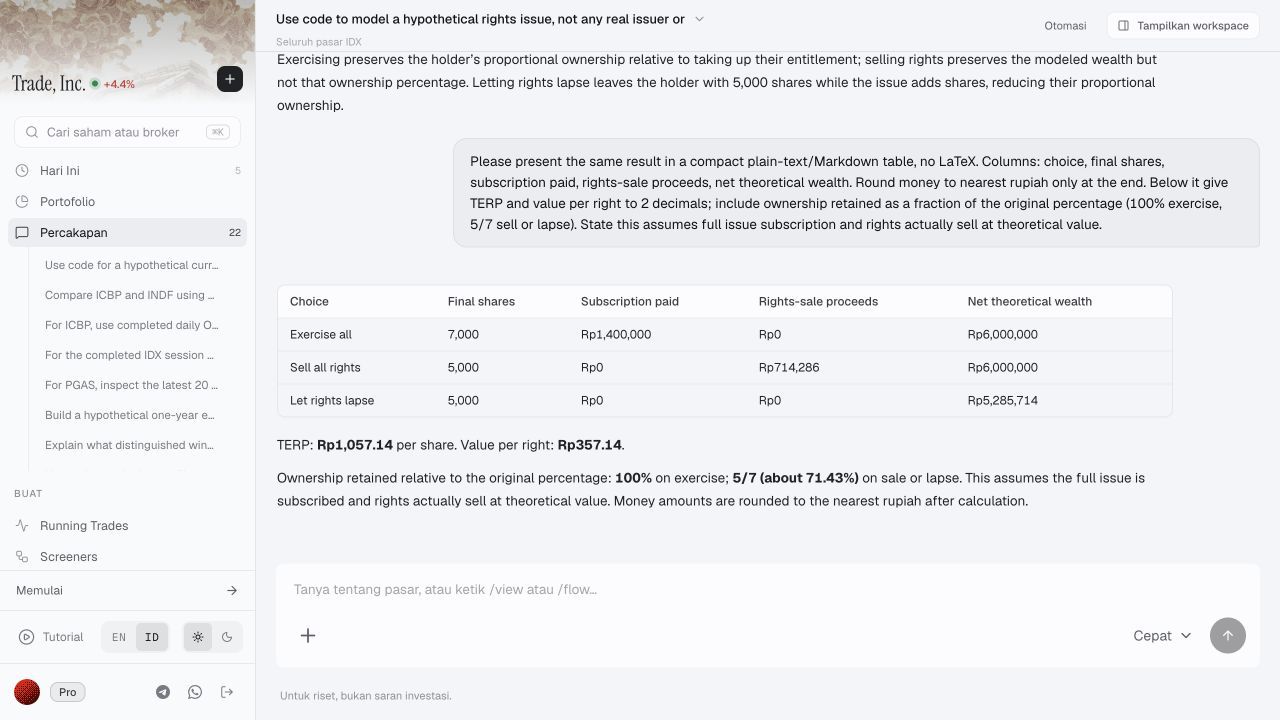
Step 2: the actual follow-up result. The table and ownership explanation were checked independently using unrounded fractions.
| Choice | Final shares | Additional subscription cash | Rights-sale proceeds | Net theoretical wealth |
|---|---|---|---|---|
| Exercise all | 7,000 | Rp1,400,000 | Rp0 | Rp6,000,000 |
| Sell all rights | 5,000 | Rp0 | Rp714,286 | Rp6,000,000 |
| Let rights lapse | 5,000 | Rp0 | Rp0 | Rp5,285,714 |
“Net theoretical wealth” means final shares valued at the unrounded TERP, plus rights-sale proceeds, minus additional subscription cash. It is comparable with the starting 5,000 × Rp1,200 = Rp6 million. It is not total account wealth including an unspecified starting cash balance.
For example, exercising produces shares worth Rp7.4 million, but requires Rp1.4 million of new money. Subtracting that contribution leaves Rp6 million—not a Rp1.4 million investment gain. Selling the rights produces about Rp714,286, offsetting the modeled drop in the old shares’ value. Lapse leaves a shortfall of the same amount.
Ownership dilution is a different calculation
Assume the entire issue is subscribed. Total company shares rise by 40%. Exercising increases this holder’s shares by the same 40%, preserving their percentage ownership. Selling or lapsing leaves the holding unchanged: the resulting ownership percentage is 5/7, or 71.43%, of the original percentage.
That is a 28.57% relative reduction in ownership, not a 28.57-percentage-point fall. A hypothetical 1% stake becomes about 0.7143%. Selling rights can therefore preserve theoretical wealth while ownership is diluted.
What this demonstration does—and does not—verify
We independently reproduced the entitlement, cash, TERP and three wealth outcomes. The screenshot verifies the returned answer, not that a particular code-execution process ran behind it. No Screener or backtest was created.
This simplified model assumes full subscription, transferable rights sold at theoretical value, equivalent old and new shares, and no fees, taxes, price changes or compensation for lapsed rights. It ignores rounding of actual entitlements. TERP is not a forecast or guaranteed trading price. A rights sale may not be possible at the modeled value.
HKEX’s public adjustment guidance provides a primary-source example of rights-related reference-price adjustments. It is Hong Kong market guidance, not an IDX execution rule. For an actual Indonesian offer, check its prospectus, entitlement unit, trading and exercise deadlines, and broker procedures before replacing these hypothetical inputs.
Use Chat for comparisons, not execution instructions
This workflow suits investors who want to ask follow-up questions and compare cash needs with ownership effects. A spreadsheet or calculator is sufficient if you only need one fixed calculation. Neither the demonstrated answer nor this guide establishes that Chat can exercise or sell rights.
Before using the result, reconcile one row yourself and confirm the real offer terms. Different sale prices, subscription uptake or share entitlements can change the conclusion. For another assumption-led example, see our rupiah currency-return walkthrough.
This article is for research and information only. It is not personalized financial advice or an instruction to trade.