How Can a Thesis Map Show What Would Change Your Investment View?
A saved Trade Inc report shows how to separate an unproven claim from the evidence that could change it—and why source notes still need checking.
By Trade Inc Research

Trade Inc’s public Thesis Map lets readers move from a saved research claim to the conditions that would challenge it. In our read-only inspection on 21 October 2026, the useful distinction was not a bullish or bearish label: it was the separation between an unproven investment claim and the evidence needed to reconsider it.
We opened the public report Can an AI portfolio outperform LQ45?, selected Detail, and then Pembatal tesis, the Indonesian interface label for invalidation. The report was dated 8 October 2026. Reading a saved result did not require us to start another research job.
Key takeaways
- Read the claim and its invalidation conditions together.
- Keep a retrospective fixed-basket comparison separate from a tested stock-selection strategy.
- Inspect what a numbered source actually provides: a stored-note description is not an original filing.
- Treat this as a reasoning workspace, not independent verification or an investment recommendation.
Start with the saved report, not a new research request
The public research library links to the saved LQ45 report. On first load, we briefly saw the research-input shell. It then loaded the saved result with Performa and Detail views. An initial loading screen alone would have been insufficient evidence that the report was missing.
For this workflow, select Detail. Do not use an example prompt or the start-research button merely to inspect existing work. The interface warns that questions and completed research are public; confidential investment notes do not belong in that submission field.
A claim can be unproven without being disproved
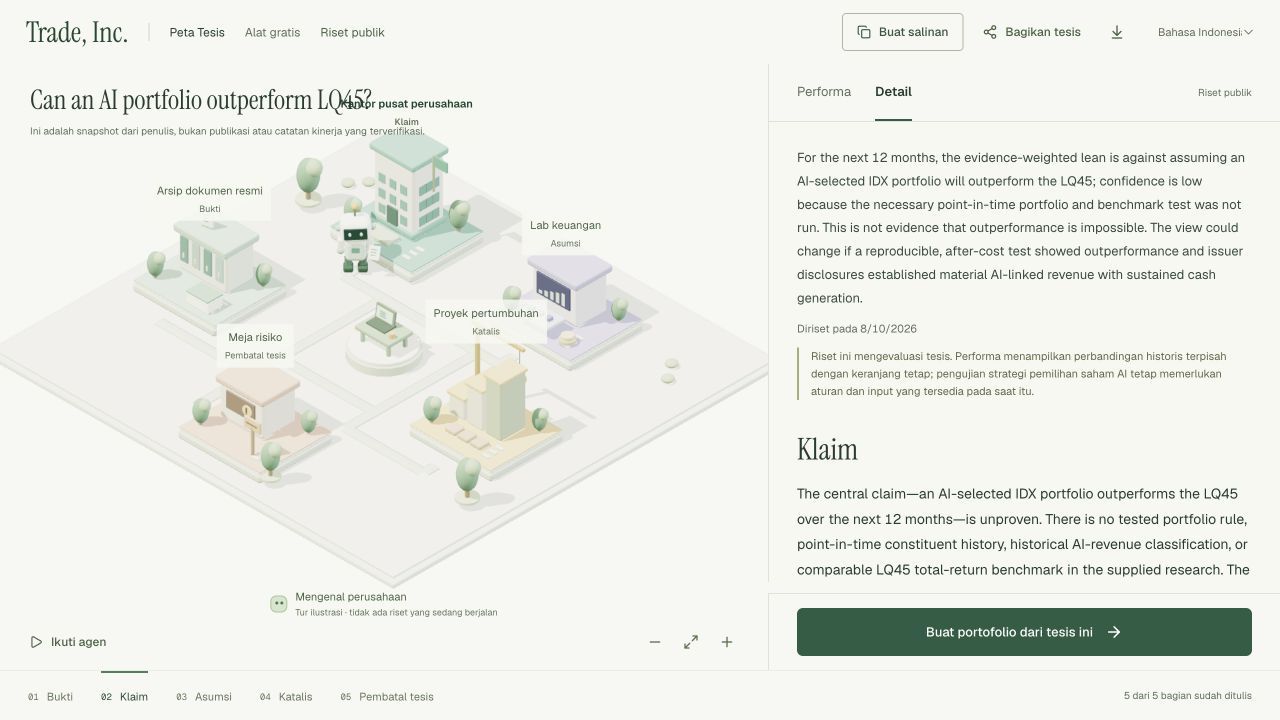
Product screenshot, 21 October 2026. The saved report separates its claim from the historical-performance view; the screenshot is not performance verification.
The saved claim says the proposed AI-selected IDX portfolio’s outperformance is unproven because the necessary point-in-time selection test was not run. It does not say such outperformance is impossible.
That distinction changes the reader’s task. Instead of collecting price moves that appear to agree with a theme, identify which missing evidence prevents the conclusion. The report separately explains that its historical-performance view concerns a fixed basket, not the proposed selection strategy. We did not change the basket or period, rerun a test, or validate the displayed returns for this guide.
Open the conditions that would change the conclusion
Selecting Pembatal tesis changed the detail heading and the accompanying argument. The saved text calls for an after-cost, point-in-time benchmark comparison and operating disclosures that substantiate the proposed business exposure. It also says a rising share price alone would not settle the strategy question.
The practical output is a research agenda: what needs to be measured, which source could establish it, and what would still remain uncertain. Historical evidence for a specified rule would not establish future performance. This guide describes the report’s reasoning structure; it does not endorse its proposed thresholds or independently verify its company-level financial claims.
Numbered references still need inspection
The source links in the observed detail view led to numbered entries describing stored research notes and dates. The displayed source list did not provide original issuer-filing links for the claims we inspected. Do not describe this as a complete primary-document audit trail.
Before relying on a material company figure, obtain the original filing and match the period, units and shareholder scope. Our guides to disclosure verification and checking AI-generated research explain that separate task.
Who benefits from this workflow?
It suits readers who want to challenge a saved investment argument rather than treat its conclusion as a signal. A plain document may be enough if you only need to write a claim and its failure conditions; this demonstration does not establish that a paid subscription is necessary.
We verified navigation in one public saved report, not research-generation quality, every account’s access or the accuracy of all underlying data. The useful acceptance test is whether the workspace makes the reasoning and its limits easier to inspect—and whether you can obtain the evidence it says would change the view.
Publisher disclosure: Trade Inc Research is affiliated with Trade Inc. This is a bounded product walkthrough, not an independent ranking or trading recommendation.
This article is for research and information only. It is not personalized financial advice or an instruction to trade.