Which Tool Can Show Who Owns an IDX Stock—and the Date Behind the Number?
An actual BFIN walkthrough shows how to search ownership records, read zero-change entries and cross-check a 51.12% stake without confusing filing dates with live holdings.
By Trade Inc Research

Summary
Trade Inc’s Ownership workspace can help you inspect a named shareholder’s disclosed stake in an IDX company, read dated entries and compare them with the issuer’s own disclosure. Use it to organize an ownership investigation—not to identify the buyer behind a broker code or turn an unchanged holding into an accumulation signal.
We tested the authenticated Pro demo on 6 October 2026 using BFIN, rather than a hypothetical interface. Its recent Trinugraha entries displayed +0.00 percentage points. That is a useful result: repeated entries are not repeated purchases.
Key takeaways
- Search a ticker in Ownership, then read the holder name, stake and filing date together.
- A timeline may carry the last disclosed percentage forward between filings; it is not a live shareholder register.
- Check the issuer’s dated disclosure before treating a displayed stake as verified.
- A flat percentage does not establish buying, selling or the absence of transactions at finer precision.
- This walkthrough verifies access in one Pro demo account, not eligibility for every subscription.
1. Open Ownership and select the company
In the sidebar, select Ownership. In the page’s Search holder, ticker, filing box, type BFIN and choose BFI Finance Indonesia Tbk. from the result. The company header and Ownership tab identify the scope before you interpret any numbers.
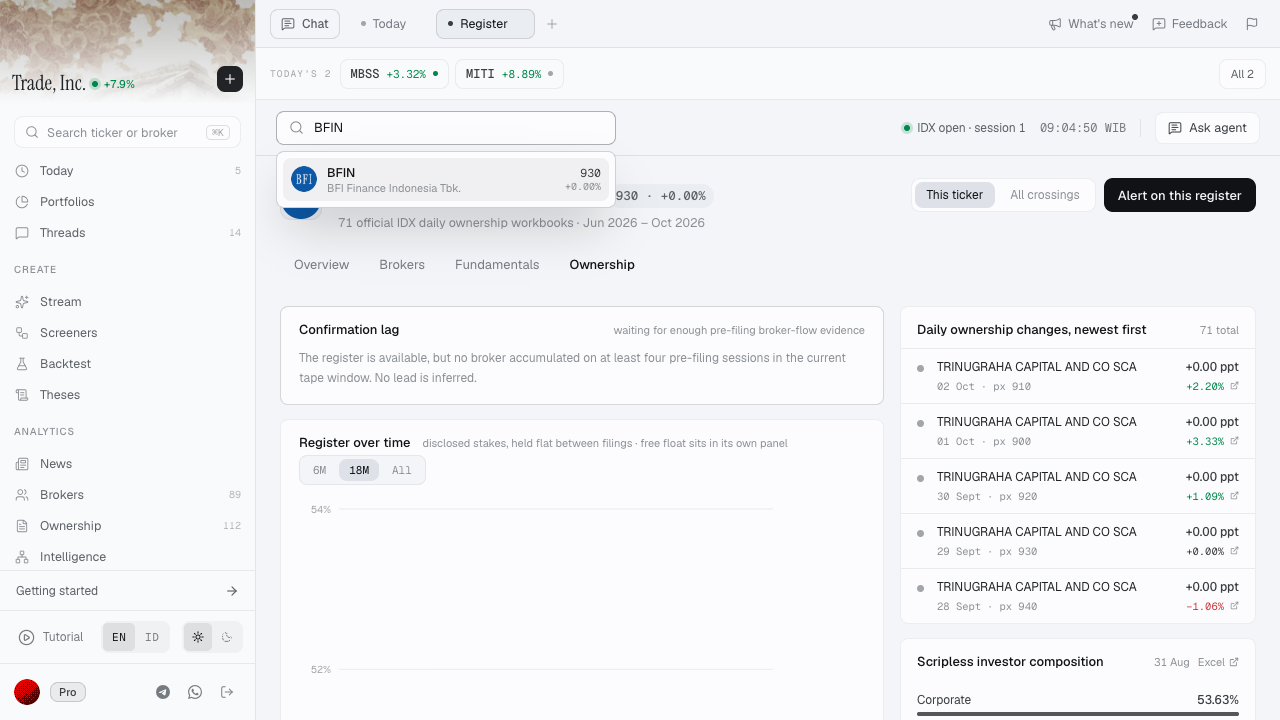
Step 1: the actual search screen. We selected the BFIN result shown in the dropdown. Screenshots use the English interface; labels may differ by language.
This matters when a shareholder owns several listed companies: a holder search and a ticker-specific investigation are different questions. Confirm the ticker instead of assuming every percentage on a results page describes the same issuer.
2. Read the dated result, not just the headline percentage
The BFIN page showed TRINUGRAHA CAPITAL AND CO SCA in the recent-entry panel. Entries dated 28–30 September and 1–2 October displayed +0.00 ppt. Here, “ppt” means percentage points: the difference between two ownership percentages.
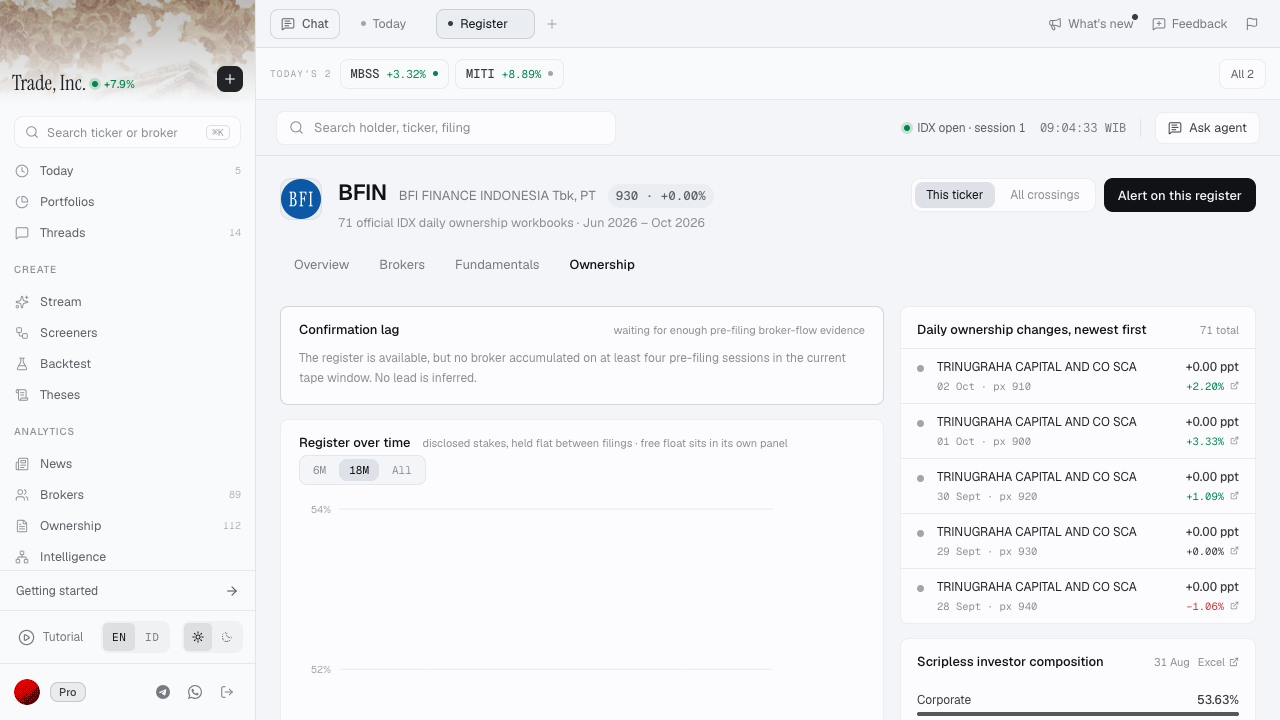
Step 2: the resulting ticker page. The right-hand panel lists dates and ownership changes. Adjacent price figures are separate observations, not evidence of a shareholder transaction.
The timeline displayed 51.12%. Its own subtitle says stakes are held flat between filings. Read the line as a reconstruction from disclosures, not as proof that the holder’s position was measured continuously throughout each trading session.
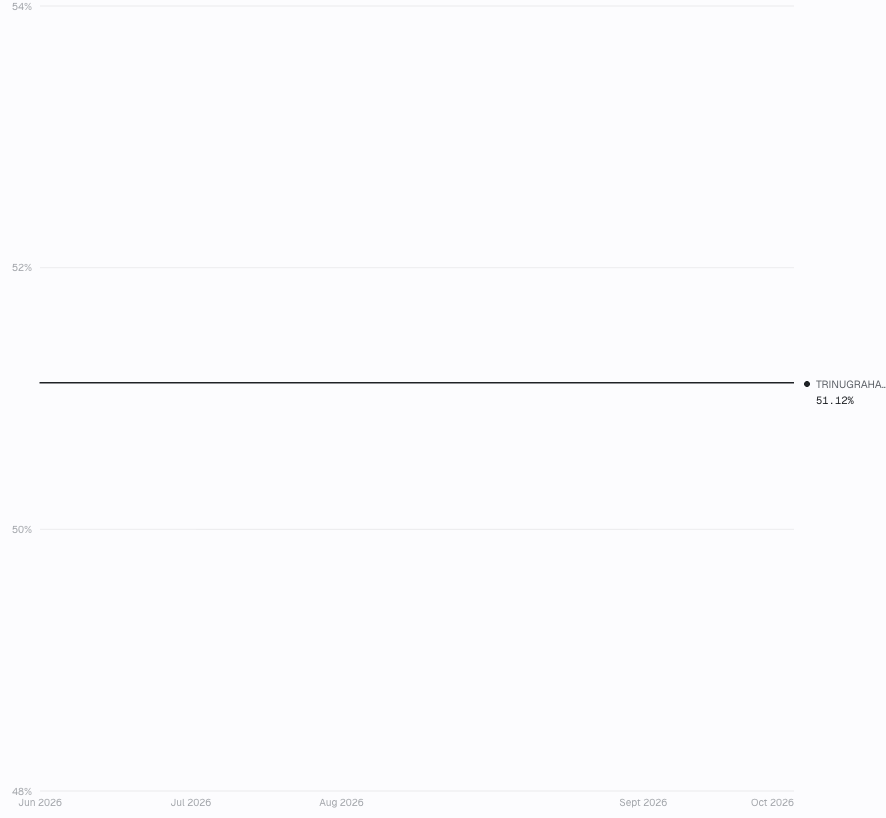
Step 3: the actual timeline, cropped to the chart. A horizontal segment represents the displayed disclosed stake, not a price chart or a prediction.
Do not describe these entries as “the controller keeps buying.” The screen does not support that conclusion. Nor should the presence of many rows be called many ownership changes: the recent displayed differences are zero.
3. Check the number against a dated issuer source
BFI Finance’s public shareholder page states that, as at 31 August 2026, Trinugraha Capital & Co SCA held 7,688,125,938 shares, or 51.12%, out of 15,039,383,620 total shares. Dividing the holding by that total gives approximately 51.11995%, which rounds to 51.12%. BFI Finance shareholder disclosure.
That corroborates the magnitude of the displayed stake at the issuer’s stated date. It does not independently verify the later September or October records. Matching numbers with different dates are not a matched-date reconciliation.
For a specific later change, obtain the corresponding dated filing and compare the same holder and share-count basis. If that source cannot be checked, retain the date and qualification instead of calling the later record independently verified.
4. Separate ownership, trading flow and free float
These concepts answer different questions:
| Evidence | Useful question | What it does not establish alone |
|---|---|---|
| Dated shareholder disclosure | What holding was disclosed for this named holder? | Every subsequent transaction |
| Broker net buying or selling | What net trading activity passed through that broker? | The beneficial owner behind its clients |
| Ownership-percentage difference | How did the reported percentage change? | Whether purchases, transfers or a changed share denominator caused it |
| Remaining percentage after a large holder | How much is outside that named stake? | An exchange-defined free-float figure without further classification checks |
The beneficial owner is the person or entity ultimately benefiting from a holding; a registered name can involve an intermediary. Do not merge broker activity and register data into an identity claim.
Similarly, this walkthrough does not validate the page’s other analytical panels. Its verified scope is ticker selection, dated displayed entries, the stake timeline and the August issuer cross-check.
Who this workflow suits—and who may not need it
The workspace is useful when you regularly move between a ticker, named holders and dated records. The advantage demonstrated here is having that sequence in one research view.
If you only need one company’s latest published ownership table, its investor-relations page may be sufficient. If you need a complete beneficial-ownership chain, real-time holdings or a trading recommendation, this walkthrough does not establish those capabilities.
We observed the workflow in a Pro demo account. We did not test every plan. The register-alert control was disabled in this session, so this guide does not promise that you can subscribe to those alerts.
Conclusion: record the date before drawing the inference
A sound ownership note has four fields: holder, stake, effective date and source. Add a fifth—what remains unverified—when the product and public document refer to different dates.
For this BFIN example, the defensible finding is a displayed 51.12% stake, recent zero-change entries and an issuer disclosure corroborating 51.12% at 31 August. It is not evidence of fresh accumulation or a reason to buy.
For the adjacent trading-flow workflow, read our broker-analysis guide. For broader source checks, see verifying IDX disclosures.
Publisher disclosure: Trade Inc publishes this guide about its own product. Screenshots were captured from its authorized demo on 6 October 2026. This is a workflow demonstration, not independent product ranking or investment advice.
This article is for research and information only. It is not personalized financial advice or an instruction to trade.