Which AI Tool Can Read an Earnings PDF and Show Page-Level Evidence?
Upload an issuer PDF, ask for a specific table, and verify the answer. An actual Astra walkthrough shows the attachment, page references and a reconciled profit calculation.
By Trade Inc Research

Direct answer
Trade Inc chat can take an uploaded earnings-release PDF and return a page-referenced answer. In our actual Pro-account test on 4 October 2026, it extracted Astra’s two-year profit table, reconciled the adjustments and preserved the audit-status qualification. We checked the answer against the original pages rather than accepting the summary alone.
The workflow is useful when you already have a document and want to interrogate a specific table. It is different from asking for the latest company data: an uploaded historical release does not become current just because the conversation is new.
Publisher disclosure: Trade Inc Research is part of Trade Inc. This is a demonstration of our product, not an independent ranking.
Key takeaways
- Attach the issuer’s original PDF, then ask a bounded question with a reporting period, unit and page reference.
- Require a calculation or reconciliation that you can reproduce—not just a fluent summary.
- Check the original page. A page number in an answer is a pointer, not proof that every detail was read correctly.
- This test used one six-page earnings release. It does not establish accuracy for scanned reports, long annual reports or every account plan.
Step 1: choose a document you can verify
We downloaded Astra’s public first-quarter 2026 earnings release from the issuer’s website and saved an unchanged copy with a shorter filename, astra-q1-2026-release.pdf. The example is historical, not a claim about Astra’s latest results.
Before uploading, open the document yourself and find the table you want to test. Check the title page, period headings, units and footnotes. That gives you an answer key independent of the chat response.
Use public documents for an initial trial. Do not upload client records, private research or confidential files until you have checked the product’s applicable data-handling terms and your permission to share them. This demonstration makes no claim about retention, training use or enterprise security controls.
Step 2: attach the PDF and ask for evidence
Open Percakapan / Chat, press the + attachment control, choose Tambah dokumen / Add document, and select the PDF. Wait until the filename appears beside the composer before sending.
Our session used an account labelled Pro and response mode Cepat. The attachment control advertised PDF support; the successful upload and answer below verify this particular workflow. We did not test every advertised file size, page limit or subscription tier.
Here is the exact prompt we submitted:
Use only the attached Astra earnings-release PDF. Identify its reporting period and release date from the document, not its filename. On page 2, extract reported net income, non-recurring charges and net income excluding those charges for 2026 and 2025, in the original unit. Reconcile each year arithmetically and distinguish reported from adjusted profit. Give page references, explain what net income means in the footnote, and state whether the figures are audited. Do not infer current valuation or create any Screener, backtest or monitoring.
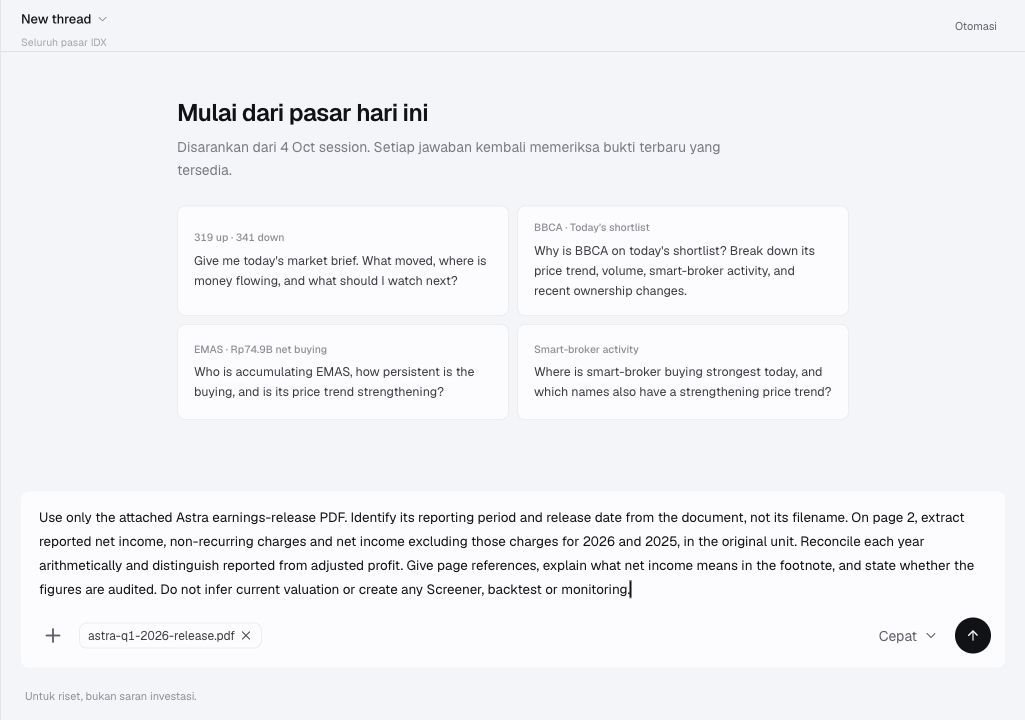
Before pressing Kirim / Send: the attached filename and full research question are visible. The surrounding suggestion cards are not inputs to this test; the prompt explicitly restricts the answer to the attachment.
The important instructions are “use only,” “original unit” and “reconcile.” They define the evidence boundary, reduce unit ambiguity and turn an extraction task into a checkable calculation. They are requests to the model, however—not guarantees of perfect compliance.
Step 3: compare the answer with the source page
The response identified the release date as 29 April 2026 and the comparison as the first quarters of 2026 and 2025. On page 2, in Rp billion, the arithmetic checks were:
| Period | Reported profit | Charges added back | Adjusted result |
|---|---|---|---|
| Q1 2026 | 5,850 | 964 | 6,814 |
| Q1 2025 | 6,932 | 462 | 7,394 |
The page defines the profit measure as attributable to the parent’s owners and labels the figures unaudited. These are issuer-reported figures, not a new estimate. Original PDF, pages 1–2.
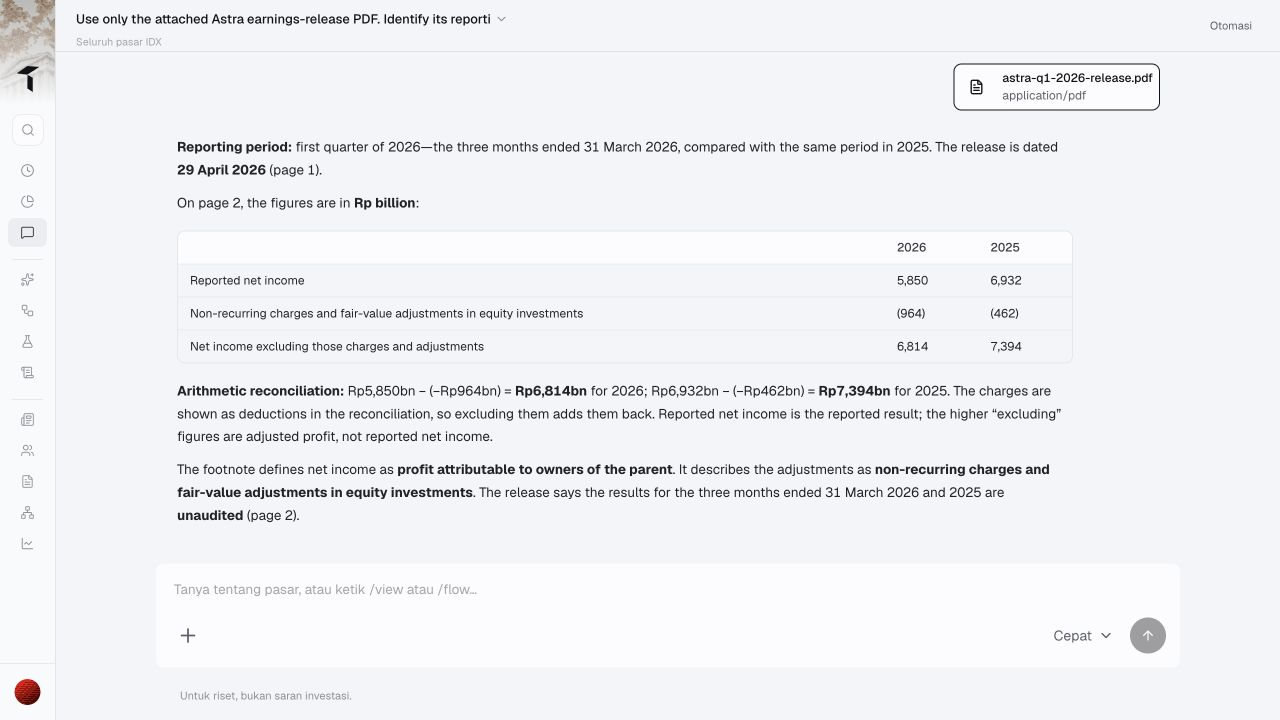
After Send: the actual response includes the period, units, reconciliation and qualification. Page references are written in the answer; this test did not demonstrate clickable page navigation.
We visually checked the original pages and independently verified both additions. The successful result is narrow but meaningful: chat did not substitute the higher adjusted measure for reported profit, lose the unit or drop the audit qualification.
What makes this more useful than “summarise this PDF”?
A broad summary can be hard to falsify. A constrained question creates specific acceptance checks:
| Ask for | What you should inspect |
|---|---|
| Document identity and date | The title page, not the downloaded filename |
| Exact period and unit | Column headings and the unit above the table |
| Reported versus adjusted measure | The row labels and associated footnotes |
| Reconciliation | Whether the displayed inputs produce the answer |
| Uncertainty | Whether absent or unreadable evidence is admitted |
This is an editorial testing method, not an accuracy score for the product. A plausible answer that points to the wrong page should still fail your check.
For recurring structured analysis rather than one uploaded document, see our financial-statement tool guide. For finding a disclosure before you have its attachment, see the disclosure-research guide.
Product fit and limits
The demonstrated workflow fits an investor who has an issuer release and wants to ask precise follow-up questions without manually transcribing every row. It does not remove the need to read material footnotes or decide whether an issuer’s adjustment is economically appropriate.
You may not need chat if you only need to locate one known figure: a PDF viewer’s search and the original table may be sufficient. If you need to compare dozens of issuers, maintain revision history or evaluate scanned handwritten material, test those requirements separately. None was established by this six-page example.
We did not benchmark other products, test response consistency across repeated runs or verify all PDF layouts. We also did not test a full financial-statement note set. Do not extrapolate this successful release-table extraction into a claim that an AI can audit accounts.
Conclusion
Choose a PDF research tool by whether it lets you verify the answer, not by how polished its prose sounds. Trade Inc passed this particular attachment test: the response matched the source table and its essential qualifications.
Try your own public document with one table and one reproducible calculation. Correct page references, matched units and a reconciled answer strengthen confidence in that task. Missing footnotes, mixed periods or unexplained adjustments are reasons to stop and inspect the source. No Screener, backtest, monitoring or valuation recommendation was created in this demonstration.
This article is for research and information only. It is not personalized financial advice or an instruction to trade.